Showing posts with label mountains. Show all posts

Wednesday, 4 January 2017

And I Went West on a Cycle

Tatte idly for breakfast is a swell option on any given day. When you are one among the 9 cyclists who have cycled a minimum of 30km on a chilly December morning from Bengaluru to Harohalli, a breakfast like this is an absolute delight. With our muscles just about warmed up and our minds well made up for a ride that would take us to Mysore that evening, 16 tatte idlys topped with a wad of butter, and 22 uddin vade and maddur vade were devoured in no time among the nine cyclists.

Manish, one of the riders from Bangalore Bikers Club riding with us, had found the first breakfast place for us. I say first because it was the first day of a 6-day ride along a route charted to take the riders from Bengaluru to Mysore to Madikeri to Kalpetta to Ooty to Mysore and back to Bengaluru. Riding over 100km on each day, the ride would total more than 700km. Attempting this whole ride, along with the aforementioned three, were Santosh and Sriram (who hadn’t joined us yet, and unfortunately couldn’t ride beyond Mysore due to unavoidable circumstances). An exam restricted Vasanth until Madikeri and a wedding restricted Vasisht and Varun until Mysore. Along with Jineshwar, I was the only other rider in the group who hadn’t done long distances yet.

My cycle was a mere week old and had seen only 18km of riding; the trip I made to decathlon and back for all the cycle accessories was the only ride on it. Despite lacking prior long distance cycling experience, I had backed myself to ride until Madikeri, a distance of 260km over two days, with the second day poised to take us through some tough inclines on the Western ghats.

As we were finishing our breakfast, another customer to our breakfast place asked us where we were headed. When Vasisht told him our final destination, the incredulous response of “Ooty na?!” had all of us in laughter! I wonder how he’d have reacted had he known that we were going via Madikeri (which is a detour from Mysore). Townsfolk everywhere seemed to be fascinated by this group of riders, who were riding what must have been to them fancy cycles, and wearing fancy attires of reflective jacket, helmet, and sunglasses. Later that day, while riding on towards Mysore after lunch in Malavalli, someone having his curiosity raised by seeing a few of our riders already, stopped me to ask where we were headed. The next day, a goods auto decided to ride slowly next to me to ask about us. Again on the second day, when I’d stopped for a tender coconut break, one of the people sitting under the shade of the thatched roof of the small shelter observed - what he decidedly thought was irony in life - that people like him desired motor bikes, while we desired such cycles.
Group of nine riders on fancy cycles and wearing fancy attires.

Among these reactions, the best always were from the kids. I had a conversation with a couple of kids, one of whom owned a cycle, near the same place where I had the tender coconut break. I asked the kid sitting on the cycle, “ಸೈಕಲ್ ನಿಂದಾ? (Is the cycle yours?)”
He replied, “ಹೌದು. (Yes.)”
“ನನ್ ಜೊತೆ ಬರ್ತಿಯಾ? (Will you come along with me?)”
“ಮಡಿಕೇರಿ ಸ್ವಲ್ಪ ದೂರ ನಂಗೆ. (Madikeri is a little too far for me.)”
As I rode on after this conversation, he sped by with his friend seated behind him. The moment they were ahead of me, the kid on the carrier lifted his hands as he rejoiced overtaking me!

When I was riding alone on the inclines of the ghat section, a bunch of kids asked me where I was going. When I said Madikeri, I heard the entire bunch go, “Come on anna, super!”

We also happened to ride next to a school that apparently had just ended for the day. There were a lot of kids with cycles, just pushing them along, walking with friends. They obviously needed the cycle to reach school on time, early in the morning. Now they were in no hurry to go back home. Why would they want to part with friends so soon?


Kids everywhere mostly greeted us with cheers and shouts of “ಅಣ್ಣ (brother)!” Raise your hand, and they will cheer more loudly for you. These kids got me thinking if I was having enough fun riding, because they seemed to have a lot more fun just cheering for us. Whether we were riding under the hot sun or were being careful to avoid the traffic, seeing kids cheer for us always made me smile and I always raised my hand for them.

Even though such incidents could infuse one with enthusiasm, riding long distances can prove to be an energy draining affair too. An injury forced Jinesh back from Mysore. Vishwa’s cycle had a flat tyre on the first day and broken spokes on the next. The blistering afternoon sun forced me to take more water breaks than I’d intended. I had to ride with a stomach ache for over half the distance on the second day. As we got closer to the ghat sections on day two, the roads became narrow, which meant more vigil on our part was needed. Although the ghat sections themselves were beautiful to ride on, we had to watch our pedal to stay away from the traffic coming from both directions and the fact that it was dark made it more difficult. And despite being mentally geared up – literally geared down – for the inclines of the last 14km to Madikeri, I found myself huffing heavily to make steady and slow progress. When I was on the edge, what perhaps irritated me the most were the badly timed speed breakers! A speed breaker on a downhill meant that I couldn’t build great momentum and one on an uphill meant it slowed down an already slow rider. When the riding got tough, I sometimes motivated myself by reminding myself that every next pedal took me to a personal best distance.
Just before the inclines to Madikeri got steeper.

On both evenings, we reached our destination with tired legs, but with triumphant minds. I personally felt more elated in Madikeri, as I’d completed a grueling climb that had me panting loudly with every pedal. And given how much tougher the Kalahatty climb on day 4 was expected to be than this, I also felt satisfied in not carrying on. And reflecting on the ride over the two days, I kept going back to the sunset I witnessed on the way to Mysore.
And we'd made it to Madikeri!

The sun, a little to the left of my view, had started sinking behind a small hill. Emitting the last red hues of the evening, the sun was setting quickly, with heat also sinking along with it. There were a few trees by the road and the traffic was moderate. Soon, the sky was bereft of the sun. I was sailing peacefully on the roads, chasing the already set sun.

PS: for a day to day account of the full 6 day trip, read Santosh's post here.

Wednesday, 31 August 2016

The Call of the Mountains

The human species is a dwarf when compared to the mountains; a dwarf in space and time. While the enormity of the mountains is immediately apparent, the mountains have existed for far longer than the human kind and perhaps will also stand witness to the demise of this sorry species. With my mind preoccupied with these thoughts, I saw the mountains standing shoulder to shoulder, stretching endlessly. I was instantly filled with a sense of awe, feeling belittled all the while. This hubris-check was felt at the foothills; foothills of one of the youngest mountain ranges and the tallest mountain range in the world. I had arrived at the foot of the mighty Himalayas. The very thought of the enormity that was in store for me over the next fortnight made me bow my head down to these mountains.

A question that I often asked myself on my second ever visit to the Himalayas was this: what makes these mountains so fascinating and why am I drawn towards them so much?

Did the fascination lie in the changing landscapes of this brilliant mountain range? We crossed the 5583m high Parang La (La is the word for pass in local tongue) on day four of our trek. The initial two days were short and they passed with relative ease. The third day saw us making steep descents which took us to a deep ravine and also saw us making equally steep ascents that led us to the Parang La basecamp. For three days we had trekked on a barren terrain with boulders being a common sight and never could one spot a tree. Initially on day four, the terrain was the same and snow at close quarters was seen only in patches. But that was about to change and how! On a misty drizzling day, it had taken steady efforts on my part to gradually ascend towards the pass. Behind me was the now familiar barren terrain and when I cast my eyes beyond the pass, I was transported to a different world where snow blanketed every inch of the land in front of us. Right at the pass was a huge mass of white that was the glacier. It took the guides over an hour to find a path down this glacier, after which it took us an hour of trekking to get off the glacier. As we trekked further that day, the trail led us to walk right by the river formed by the glacier water. The next day saw us wading through those icy-cold thigh-high waters. Two more days later, as we left the course of the river, we were staring at incredibly vast meadows that stretched on for miles. One was bound to gauge the miles wrongly, always underestimating it. And there was still no sign of a tree. Nature must have challenged herself to outdo the majesty and variety of her creations at every turn.

Snowfall could transform a barren peak into a snow peak overnight

The landscape didn’t change just with distance, they also changed with time. The Tso Moriri - a huge lake at an altitude of 4543m with a perimeter of about 60km - changed colours every few hours. The interplay of sun and clouds led the lake to take on varied shades of blue. A thick cloud cover in the afternoon would render the lake a deep shade of blue, while a sparser cover gave the lake a light blue shade. Different parts of the lake would assume different shades at the same instant due to the uneven distribution of the clouds. The clouds affected the mountains too with their snowfall and rain. The landscape change is so intriguing that the colour of the mountains changed just with rain, as the soil on the mountains mixed with the rain and deepened in colour. Needless to say, snowfall could transform a barren peak into a snow peak overnight. Nature must still be challenging herself to outdo the majesty and variety of her creations with every hour.

The interplay of sun and clouds led the lake to take on varied shades of blue

Nature also used the moon to paint a landscape differently. That night at the Norbu Sumdho campsite, when I crawled out of the two man tent where I was huddled along with five others and where laughter was raging for a long while, Nature had me staring at her painting for a long time, speechless. The waxing crescent moon lit up the landscape; the gently flowing glacier water – the gentleness also heard in the sound that she made - was now streaks of silver on the path below, a path that she had long ago forged among the mountains and the mountains themselves were now a silhouette of black all around. The unflinching clouds which decorated the sky, especially gathered around the peaks, seemed to be competing with the stillness of the mountains. A multitude of stars completed this picture of few colours. The still cold air was chilling my bones. Yet I stood, transfixed, moved by the majesty and beauty of this incredible sight.

I know that it isn’t just the changing landscape that draws one to the mountains. The white band of Milky Way was seen on many nights, stretching across the sky, reminding the consciousness induced stardust that we are of our origins and of our place in the universe. On the trek, we saw a lone wolf limping away, herds of kiangs grazing, marmots popping in and out of their holes, bar-headed geese on the lake, and a hare ran past us! Being severed from civilization, in the mountains, we are a lot closer to Nature.

At the end of the trek, I still couldn’t convincingly answer why I was so fascinated. Hindsight also hasn’t proved to be successful in the quest for an answer. But it is perhaps not a question that should be answered at all. I’m inclined to think that the question is invalid even.

All I’m left with is this. The Himalayas called. I obliged. And I will continue to answer them, for I have fallen prey to the calls of the mountains.

Tuesday, 21 June 2016

A glimpse of the green grandeur of the Western Ghats: Kumaraparvatha

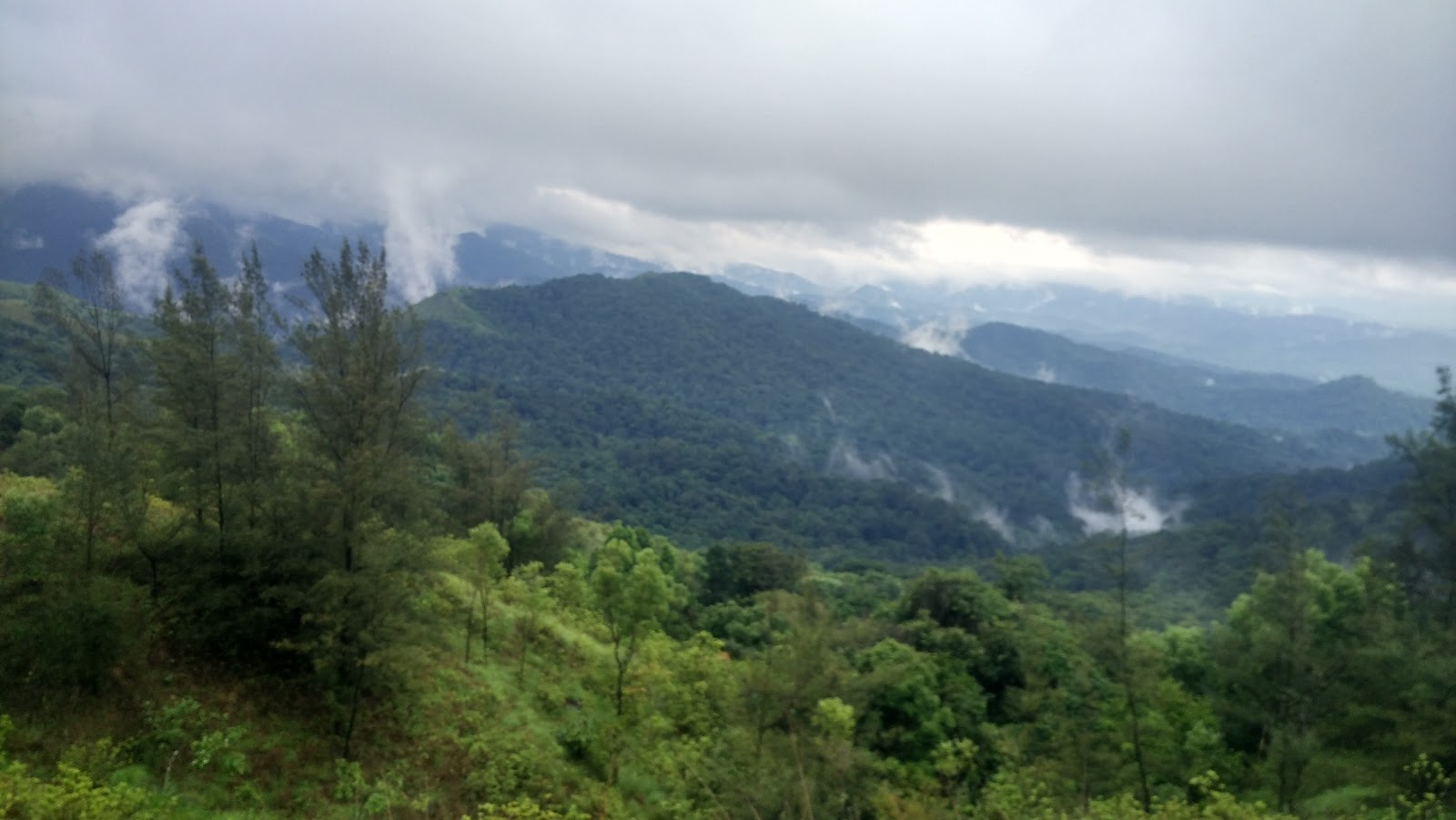
An undulating and never-ending mass of green all around was the view that I was offered by the Western Ghats as I sat on the rock, facing the towering Kumaraparvatha. The clouds drifting all around added to the charm of the view. Kumaraparvatha stood taller than the other peaks around, like it was standing guard over them and the wildlife that inhabited them.

It had taken us 3.5 hours on a steadily ascending path from Kukke - trekking through tall trees, some leeches and the occasional snake – to reach the midway point (Bhattara mane) of this Kumaraparvatha trek. Despite it being the season for rains, it didn’t rain until we reached Bhattara mane. And it was an hour past noon already. But once we reached that point, rain was unpredictably on and off. The forest department was quite strict about not allowing us to trek past that point and quite understandably so; in a recent incident, lightning strikes had claimed lives. We had the entire evening to ourselves. An evening of nothingness to look forward to, with a large expanse of mountains to immerse ourselves in. Brilliant, no?

The cloud cover was a near constant and rains were very unpredictable. Heavy bouts of rains were separated by mere minutes, which made sure that we all were constantly draped in our ponchos or raincoats. However, as the evening wore on, there was a point when the rains did subside. The clouds were still among us and it seemed like the clouds were rising up from the valleys below, to join the bigger ones hovering above us.

The cloud cover was a near constant...clouds rising up from the valley
We found a smaller peak which we wanted to trek to and we occupied that for the rest of the evening to come. From this point, towards west, we could see the civilization below where the mountains ended. We could also make out the trail of the Kumaradhara river below, as it coursed through the woods. The river in itself wasn’t seen, but the clouds rising up from the path of the river plotted its slender path. To the east of the point lay the Kumaraparvatha. And on the other two sides, the clouds, mountains, trees and greenery completed the view.

About time for the sunset, I sat myself on one of the rocks around, admiring the huge mound of green in front of me. Calling it a mound of green doesn’t do enough justice for many reasons. One of them being that there were many varied shades of green. The grass and trees, feasting on the frequent rains, had produced innumerable and rich shades of the same hue. Also, setting sun playing behind ever moving clouds created such varied effects on the greens and the towering peak. All the clouds around us seemed to be attracted to the peak, offering different amount of cover to the peak, as though they were guarding the peak from the prying, hungry eyes of the people at its base.

Clouds seemed to be guarding the flat peak
There weren’t any signs of animal wildlife in these spots of the mountains; none if you exclude the leeches! The animals stay away from humans, I was told. The next day though, I would wake up to the song of a whistling thrush! How delightful was his song, whistling away to himself, safe from our eyes. The Himalayan whistling thrush supposedly stops whistling midway through, like he’s forgotten a note. This fellow in Western Ghats seemed like he knew his notes all too well. Or maybe he composed them all too well.

Back to my place on the rock, the cloud and sun combination allowed us the privilege of just a glimpse of Kumaraparvatha’s rather flat peak, a glimpse which lasted for just a few seconds. The moment was met with a collective aaahhh! I wondered if that was the Ghats' way of telling us that we humans should be limited to mere glimpses, and that if we're given more, we'd probably not leave them the way we saw them. At that moment though, the rock I sat on was the perfect place to savour this glimpse. Had I stood up and walked a few paces westwards, I’d have seen sights of civilization down below. But on this rock, there was no civilization to ruin my experience. I could as well have been in heaven. Really, at moments as special as this, seated as perfectly as I was, I start wishing for heaven to be real and for it to be an experience akin to this. But perhaps I’m looking at it in the wrong light. The heaven that I was wishing for would be a heaven worth dying for. The heaven that we have here is a heaven that’s worth living for.

Friday, 29 May 2015

Pushing the frontiers of my endurance... Rupin Pass

I had to push myself on. I couldn't take more than three steps at a stretch. My body refused to move. The 10kg rucksack on my back felt heavier than that. Resting on my trekking pole, I had to take a few deep breaths, compose myself and carry on. The occasional sip of water didn't seem to help much. Every next step took more effort than the previous. But I also knew, that every next step took me that much closer to the top.

It was day six of the seven day trek to Rupin pass. It was the day we'd actually cross the Rupin pass. We left our camp at upper waterfall at 5:30am and so far, this day had proved to be the most grueling. After three days of rather plain sailing, I had suffered from acidity. Now at 15k feet, it looked like I had a hint of altitude sickness too. Having trekked for three full hours on snow, where the micro-spikes and trekking pole had saved me from many a fall, I was looking at a steep ascent of 60 degrees where one had to walk zigzag on the slope to reach the top of Rupin pass.

Having navigated the initial climb up with the help of constant motivation from Ragha behind me, we reached the rope section. I climbed up holding the rope, taking a few breaks, some of which were enforced, some voluntary. My lungs were gasping for more air, my legs were crying out for a rest and my hands didn’t want to hold anymore. But my mind, which knew better, told them all to stop whining and get on with their work and finish the ascent. The rope climb was done with and exhaustion was taking over me. The last few feet, to be covered on feet, were beckoning. And the people above who had already reached were calling out.

We were a group of eighteen trekkers, led by three trekking staff of India Hikes, who in turn were assisted by three more technical staff members to navigate sections such as these. We had grown close over the days as a group. It was a group with an interesting mix. The group had first time trekkers and veteran trekkers, had a few amateur and pro photographers, had people from many parts of India and even one from Malaysia. But most importantly, it was a group that knew how to have fun together!

It probably was their shouts, combined with the knowledge that I had very nearly made it, which gave me a sudden surge of mental energy. Now I knew that I had enough in me to finish the ascent without any more breaks. Weary, yet headstrong, taking one tough step after another, with one heavy breath after another, using my hands, my knees and the last sinew of my resilience, I trudged along until there was no more to climb. I had finally ascended the Rupin pass!

Rupin Pass: 15350 feet above sea level
I threw myself on the ground and let the wave of emotions rush through me. The first was of satisfaction. Satisfaction that I could discover my new physical and mental limits, satisfaction that those were enough to finish the climb. Now that the climb was done, looking around, I felt delighted by the sights the mountains and the sky offered. I might use the most superlative form of breathtaking to describe it, and still fall short of explaining Nature’s beauty up there. A new found energy and zeal were now running in my veins. Had I really conquered this height? No. Now I felt humility too, as I had this weird sensation that it was the mountains which allowed me to reach these heights.

We all spent some time there, absorbing everything, taking pictures and congratulating each other. When at last we started to depart, I was the last to pick my backpack up again. As I stood there, I couldn't help but remark how beautiful everything looked. This was an utterly beautiful experience; not just a beautiful place, but an experience. Standing alone, amidst the pure white snow, I looked up at the clear blue sky. It held nothing but the bright sun. Not a single speck of cloud was seen. It was then that I had an epiphany of sorts, about reality and our place in the universe.

The view from Rupin pass
"Here I am, standing at 15,350 feet on the planet Earth. In the solar system, we're just a pale blue dot. A pale blue dot that is going around quite a small star of our galaxy. The star is merely one among the billions in our galaxy. Our galaxy just one among the billion others. Yet, in all that insignificance, the joy and beauty of Nature perceived by this speck of consciousness is overwhelming."

I had goosebumps just then. And I don't think the cold had much to do with it.