Wednesday, 31 August 2016

The Call of the Mountains

The human species is a dwarf when compared to the mountains; a dwarf in space and time. While the enormity of the mountains is immediately apparent, the mountains have existed for far longer than the human kind and perhaps will also stand witness to the demise of this sorry species. With my mind preoccupied with these thoughts, I saw the mountains standing shoulder to shoulder, stretching endlessly. I was instantly filled with a sense of awe, feeling belittled all the while. This hubris-check was felt at the foothills; foothills of one of the youngest mountain ranges and the tallest mountain range in the world. I had arrived at the foot of the mighty Himalayas. The very thought of the enormity that was in store for me over the next fortnight made me bow my head down to these mountains.

A question that I often asked myself on my second ever visit to the Himalayas was this: what makes these mountains so fascinating and why am I drawn towards them so much?

Did the fascination lie in the changing landscapes of this brilliant mountain range? We crossed the 5583m high Parang La (La is the word for pass in local tongue) on day four of our trek. The initial two days were short and they passed with relative ease. The third day saw us making steep descents which took us to a deep ravine and also saw us making equally steep ascents that led us to the Parang La basecamp. For three days we had trekked on a barren terrain with boulders being a common sight and never could one spot a tree. Initially on day four, the terrain was the same and snow at close quarters was seen only in patches. But that was about to change and how! On a misty drizzling day, it had taken steady efforts on my part to gradually ascend towards the pass. Behind me was the now familiar barren terrain and when I cast my eyes beyond the pass, I was transported to a different world where snow blanketed every inch of the land in front of us. Right at the pass was a huge mass of white that was the glacier. It took the guides over an hour to find a path down this glacier, after which it took us an hour of trekking to get off the glacier. As we trekked further that day, the trail led us to walk right by the river formed by the glacier water. The next day saw us wading through those icy-cold thigh-high waters. Two more days later, as we left the course of the river, we were staring at incredibly vast meadows that stretched on for miles. One was bound to gauge the miles wrongly, always underestimating it. And there was still no sign of a tree. Nature must have challenged herself to outdo the majesty and variety of her creations at every turn.

Snowfall could transform a barren peak into a snow peak overnight

The landscape didn’t change just with distance, they also changed with time. The Tso Moriri - a huge lake at an altitude of 4543m with a perimeter of about 60km - changed colours every few hours. The interplay of sun and clouds led the lake to take on varied shades of blue. A thick cloud cover in the afternoon would render the lake a deep shade of blue, while a sparser cover gave the lake a light blue shade. Different parts of the lake would assume different shades at the same instant due to the uneven distribution of the clouds. The clouds affected the mountains too with their snowfall and rain. The landscape change is so intriguing that the colour of the mountains changed just with rain, as the soil on the mountains mixed with the rain and deepened in colour. Needless to say, snowfall could transform a barren peak into a snow peak overnight. Nature must still be challenging herself to outdo the majesty and variety of her creations with every hour.

The interplay of sun and clouds led the lake to take on varied shades of blue

Nature also used the moon to paint a landscape differently. That night at the Norbu Sumdho campsite, when I crawled out of the two man tent where I was huddled along with five others and where laughter was raging for a long while, Nature had me staring at her painting for a long time, speechless. The waxing crescent moon lit up the landscape; the gently flowing glacier water – the gentleness also heard in the sound that she made - was now streaks of silver on the path below, a path that she had long ago forged among the mountains and the mountains themselves were now a silhouette of black all around. The unflinching clouds which decorated the sky, especially gathered around the peaks, seemed to be competing with the stillness of the mountains. A multitude of stars completed this picture of few colours. The still cold air was chilling my bones. Yet I stood, transfixed, moved by the majesty and beauty of this incredible sight.

I know that it isn’t just the changing landscape that draws one to the mountains. The white band of Milky Way was seen on many nights, stretching across the sky, reminding the consciousness induced stardust that we are of our origins and of our place in the universe. On the trek, we saw a lone wolf limping away, herds of kiangs grazing, marmots popping in and out of their holes, bar-headed geese on the lake, and a hare ran past us! Being severed from civilization, in the mountains, we are a lot closer to Nature.

At the end of the trek, I still couldn’t convincingly answer why I was so fascinated. Hindsight also hasn’t proved to be successful in the quest for an answer. But it is perhaps not a question that should be answered at all. I’m inclined to think that the question is invalid even.

All I’m left with is this. The Himalayas called. I obliged. And I will continue to answer them, for I have fallen prey to the calls of the mountains.

Tuesday, 21 June 2016

A glimpse of the green grandeur of the Western Ghats: Kumaraparvatha

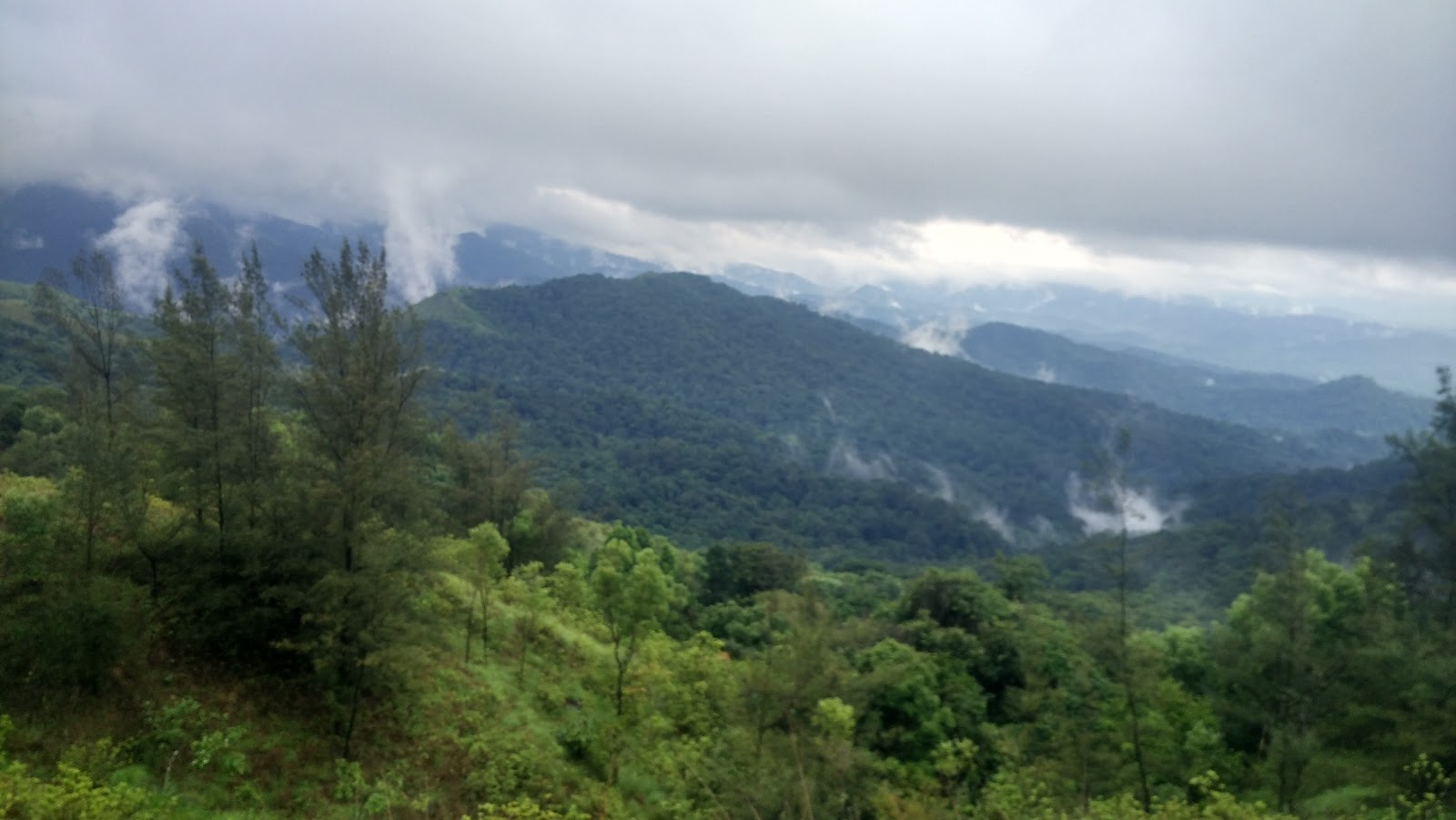
An undulating and never-ending mass of green all around was the view that I was offered by the Western Ghats as I sat on the rock, facing the towering Kumaraparvatha. The clouds drifting all around added to the charm of the view. Kumaraparvatha stood taller than the other peaks around, like it was standing guard over them and the wildlife that inhabited them.

It had taken us 3.5 hours on a steadily ascending path from Kukke - trekking through tall trees, some leeches and the occasional snake – to reach the midway point (Bhattara mane) of this Kumaraparvatha trek. Despite it being the season for rains, it didn’t rain until we reached Bhattara mane. And it was an hour past noon already. But once we reached that point, rain was unpredictably on and off. The forest department was quite strict about not allowing us to trek past that point and quite understandably so; in a recent incident, lightning strikes had claimed lives. We had the entire evening to ourselves. An evening of nothingness to look forward to, with a large expanse of mountains to immerse ourselves in. Brilliant, no?

The cloud cover was a near constant and rains were very unpredictable. Heavy bouts of rains were separated by mere minutes, which made sure that we all were constantly draped in our ponchos or raincoats. However, as the evening wore on, there was a point when the rains did subside. The clouds were still among us and it seemed like the clouds were rising up from the valleys below, to join the bigger ones hovering above us.

The cloud cover was a near constant...clouds rising up from the valley
We found a smaller peak which we wanted to trek to and we occupied that for the rest of the evening to come. From this point, towards west, we could see the civilization below where the mountains ended. We could also make out the trail of the Kumaradhara river below, as it coursed through the woods. The river in itself wasn’t seen, but the clouds rising up from the path of the river plotted its slender path. To the east of the point lay the Kumaraparvatha. And on the other two sides, the clouds, mountains, trees and greenery completed the view.

About time for the sunset, I sat myself on one of the rocks around, admiring the huge mound of green in front of me. Calling it a mound of green doesn’t do enough justice for many reasons. One of them being that there were many varied shades of green. The grass and trees, feasting on the frequent rains, had produced innumerable and rich shades of the same hue. Also, setting sun playing behind ever moving clouds created such varied effects on the greens and the towering peak. All the clouds around us seemed to be attracted to the peak, offering different amount of cover to the peak, as though they were guarding the peak from the prying, hungry eyes of the people at its base.

Clouds seemed to be guarding the flat peak
There weren’t any signs of animal wildlife in these spots of the mountains; none if you exclude the leeches! The animals stay away from humans, I was told. The next day though, I would wake up to the song of a whistling thrush! How delightful was his song, whistling away to himself, safe from our eyes. The Himalayan whistling thrush supposedly stops whistling midway through, like he’s forgotten a note. This fellow in Western Ghats seemed like he knew his notes all too well. Or maybe he composed them all too well.

Back to my place on the rock, the cloud and sun combination allowed us the privilege of just a glimpse of Kumaraparvatha’s rather flat peak, a glimpse which lasted for just a few seconds. The moment was met with a collective aaahhh! I wondered if that was the Ghats' way of telling us that we humans should be limited to mere glimpses, and that if we're given more, we'd probably not leave them the way we saw them. At that moment though, the rock I sat on was the perfect place to savour this glimpse. Had I stood up and walked a few paces westwards, I’d have seen sights of civilization down below. But on this rock, there was no civilization to ruin my experience. I could as well have been in heaven. Really, at moments as special as this, seated as perfectly as I was, I start wishing for heaven to be real and for it to be an experience akin to this. But perhaps I’m looking at it in the wrong light. The heaven that I was wishing for would be a heaven worth dying for. The heaven that we have here is a heaven that’s worth living for.

Tuesday, 24 May 2016

नक्षत्रनिर्मिताणि

विश्वावृताणि मात्राणि
तारकस्फुटनेन हि |
लोके सर्वाणि भूतानि
नक्षत्रनिर्मिताणि वै ||

Wednesday, 17 February 2016

A fond smile of recognition

It was impossible not to cry. Tears that had filled until the brim, threatening to overflow, flowed gently down my cheeks. I couldn’t quite say if I was happy or sad. Retrospectively though, I know that I was both happy and sad.

About a year and a half ago, I had undergone a rather minor laser eye surgery to stop the fluid inside my eye from overflowing through a cut which had developed when a football had struck my right eye from close range. I had frequent eye checkups since then at the same hospital, a hospital which was close to my house. A fifteen minute walk would suffice to cover the distance.

After one of my check-ups on one sunny afternoon, walking back home through one of the quieter cross roads, I saw a bunch of kids near a construction site. They were children of the workers there, clothed by dusty, ill-fitting clothes. There were about five or six of them, all playing around, running and hopping. The eldest was a girl, no older than six or seven and the rest were all younger than her by at least a couple of years. The youngest of the lot was the one held by the girl on her hip and he was barely two. Like most kids their age, they looked like a happy lot, with no responsibilities and indeed even without an understanding of what responsibility might mean.

These kids, I thought, will never have a childhood like most. Their childhood will be filled with extreme sacrifices made by their parents to just earn a day’s meal. And being in an environment where most of their wants possibly will not be satisfied, they might also outgrow their innocence soon. The sight of these children playing, having fun, oblivious to what life had dealt them, put me in a pensive state of mind. I made up my mind to make just one of their days special in a small way and walked over to one of the elders in the group. I asked if I could take them to a nearby bakery and buy them what they asked for. The man agreed without any hesitation and called out to the girl and explained that she was to accompany me to the bakery.

I asked her to tell the other kids that she would bring all the stuff for them and that they were to stay put in her absence. She did so, and came along with me, still holding the boy at her hip. As we walked to the bakery, I made conversation with her, asking her name and the place they were from (neither of which I can remember now). I held her hand and crossed the main road, across which was the bakery. At the bakery, I told her that she was free to order anything she liked and also to keep in mind what the kids we left behind would like. She took a few minutes to think of everything they’d want and once done, all her orders cost me lesser than Rs.200. I held the plastic bag with all the snacks in one hand, her hand in the other, as we crossed the road again and went back to the construction site.

She took the cover from me once we reached and thanked me for the snacks. That was one of the moments where I profoundly felt how unfair life was. For her, these snacks worth 200 were a luxury, while for me, I wouldn’t think twice about paying Rs.100 just to play football for an hour. And what I had done was in no way going to bridge this gap between me and her. However, I hoped that my small gesture would make her feel like life was being unfair in her favour, for a small while at least. These thoughts predominantly occupied my mind as I made my way home.

Many weeks later, I had another consultation and was walking home via the same route. I saw some of those children from that day, again playing on the street. I had almost reached the end of the road, where I’d turn, when I spotted that big girl in the group. Her face lit up in an instant when she saw me and waved her hand wildly at me. Glee was written on her face; her wide smile the letters. Those were smiles and waves of a happy recollection, of recognition.

Her happiness moved me in a way quite unlike anything else. I had gone from another passerby on the road to someone whom she remembered and someone who made her smile. I too smiled and gave back a hearty wave as I tried to prevent my eyes from moistening. I passed by her and made the turn, as I realised how I’d look back on this day with fondness, for years to come. I couldn’t hold the tears in any longer. It was impossible not to cry…

Friday, 12 February 2016

Gravitational Waves!

Billion years ago were two orbiting black holes
Closer they drew; they collided and merged through
Space-time fabric was warped; still it folds and unfolds
The colossal collision set off these gravitational waves
Stacking crest after trough, endlessly propagating, until time stays.


I wrote this poem to celebrate the historic day on which mankind first observed the gravitational waves directly! This poem - an acrostic - has more than the word formed by first line first letter, second line second letter and so forth. There’s another word in it. Can you find what that is?
Also, for reigniting my interest in astronomy and black holes in particular, many thanks to Usha Keshav!

Friday, 25 December 2015

Song for Life

Strung together are myriad notes
Often words too, to go along
Now the listening of the composition
Gives birth in us to emotions strong.

Souls are touched, we find respite
Or comfort in grief, or ecstasy in joy
Numerous meanings in different life phases
Gifts of music are for everyone to enjoy.

Similarly I hope to be a song
Of lyrics meaningful and melodies soulful
Now my existence I will deem successful
Given I make at least one life purposeful.

Sure the song will not last forever
One day my last note will be played
Notable, let my song be called, if it is
Given at least just one more replay.


An acrostic written and published (take that, you government!) in China.

Tuesday, 22 December 2015

Just Another Day at Work

Tired as he was, he grinned from ear to ear when he saw it.

3 hours. 14 minutes, 15 seconds. That was how much time Homicide Detective James Hardy had spent in the interrogation room. He’d just come out of the room with every inch covered in sweat, exhausted mentally and physically drained. The prime suspect in his latest assignment of the Todd double murder case was unyielding. He had gone inside the interrogation room convinced of the guilt of the suspect. A very methodical man, Hardy, had left no hair unnoticed during the investigation and after 9 nearly sleepless days and nights of relentless efforts, during which he had worked under the scrutiny of the media lenses employing his acute observation and reasoning skills, he was finally convinced of the sequence of the events. A confession from the prime suspect would seal everything up. Now at 2 in the morning, the tense situation notwithstanding, he was smiling at the picture that he had just received on WhatsApp.

Despite his firm conviction of the event sequence he had carefully and craftily reconstructed, the interrogation at some point had made him question himself. Hardy would never forgive himself if he was in any way responsible for a false conviction. He thought about how he would normally discuss every detail of the case with his partner-in-crime-detection Irene Lawrence. This case did not give him time for that. Nor did it give him Irene, because she was on her holiday, which was already put off three times. But he still had painstakingly gone over smallest of details the case presented (like the small stain of blood on the second floor window and the seemingly watertight alibi of the neighbour) at least thrice before arriving at his conclusions. During the doubtful junctures in the interrogation, he had gone over the copious details again in his head and had realized how his theory was indeed right. It had taken enormous concentration and character on his part to not just process the information the suspect was giving, but also to find a way to trap him. Having stepped out of the room after successfully extracting a confession, the weary detective continued to grin at his phone.

All he wanted now was some strong Sumatran coffee, brewed freshly from the coffee beans which were at his table, the bag still unopened. But this was only his second choice. What he truly longed for was on the rocks scotch and a night of peaceful sleep. It was a longing which started taking shape just after the confession. However, the just received picture had killed that longing in an instant. He hadn’t a choice but to settle for the second best now. Second best though it was, it didn’t make Hardy feel bad. And maybe, he thought, that was the effect of the picture he had just received.

The picture was just madness, really. Talk to any civilian about it, she’d feel disturbed at the very least. But that’s what, he figured, jobs like his drove people to. He felt more certain that without a degree of madness, one couldn’t do all the work, which involved looking at bodies over and over and at each part with total attention, looking for bodies in places where you are least likely to find them, coming up with theories about how the bodies came to be in that state, came to be where they did, then looking at the area around the body, talking to people who could in any way be related to the bodies, find those relations too on many occasions, and finally finding the somebody - people or a group of people - who was responsible for the body being there. And they invariably worked with a strict deadline. The picture was one epitome of the madness.

How the Todd double murder case alone hadn’t driven him to madness, Hardy didn’t know. High publicity and Irene’s absence had made it more difficult than it could’ve been. But more madness awaited him now. The picture had been Irene’s selfie. No, it wasn’t a selfie from her holiday trip; it was her customary selfie with the new murder victim. She was called back to work and the game was afoot again. Yet, for one last time, he smiled at the picture.